I listened to what Dilbert had to say, and I liked it.
In my neck of the woods, an embarrassing amount of time has been wasted on articles of the sort: “10 Things You Can Do Like Right Now To Become a More Awesome Person”, otherwise known as click-bait. Still, every once in a while, an article comes a long with a truly thought-provoking idea. And just like those damn long wooden beams in Hay Day, such ideas are frustratingly rare.
While looking online for what to do with my life – I’m pretty sure I’m not the only one doing that-, I stumbled across Scott Adams, the creator of Dilbert, in the Wall Street Journal talking about how goals are for losers, systems are for winners. Create a system, he says, that fits your skills and abilities, and forget about setting goals and/or following your passion. There is no failure in the system itself, only how you interpret the results. Perhaps at first, to put it kindly, they are lack luster. But with every iteration, your system gets better suited to you and eventually it will start producing what you dreamed it will.
Aiming for a particular goal, on the other hand, will make you feel like a failure until you reach that goal; if you do reach it, comes a fleeting period of euphoria, followed by the emptiness of losing the very reason for moving forward. A goal feels like a much-anticipated vacation – at least for those of us that use vacation as an escape. There’s the frustration that vacation time isn’t there already. Hallelujah, there comes the vacation, and you savour that week or two. Alas, at some point it is all over and you’re back to the way things are, disappointment.
A very useful perspective on goals indeed. Still I wouldn’t throw them out the window yet. Adams did in fact set a goal for himself:
As for my own system, when I graduated from college, I outlined my entrepreneurial plan. The idea was to create something that had value and—this next part is the key—I wanted the product to be something that was easy to reproduce in unlimited quantities.
Implicitly conveyed, financial success is his goal. The people presented as system-oriented successes also have financially arrived. Okay, I get it. It is the Wall Street Journal after all so how else would you define success on the Street. Still, despite saying goals are for losers, he did define a goal. The point is he shifted his focus from the goal and poured it all on building a system that fits his character.
My biggest take from the article is where to concentrate your efforts.
Focus on the system, and there is always room for improvement: something to tweak, something to improve, or something to angrily bang with your fist. At the beginning, you kind of expect it to fail. Few are so full of themselves to believe their system is perfect from the get go. This hope that “I can make this better” lights the motivation fire. And man, do I miss this “I am making something cool” feeling!
Focus on the goal on the other hand, disregard the system, and you’ll find yourself limited to one of three states: (1) did not reach the goal, (2) yay I made it and (3) ok, that’s done and over, what now? It’s a recipe for short-lived euphoria and staying disappointed most of the time.
The goal, in end effect, is a marker or a guideline. The path is the journey that is life. And the system is the vehicle you build yourself to travel down that path. The end is looking back on the path you traveled, the milestones you crossed, and feeling a sense of contentment that the journey was all worth it.
Where to go with all of this? Yes, it is rich food for thought but I don’t want this to end up as yet another great idea archived in my head only for me to slip back into autopilot mode. This time I want to take this as far as it can go, dig into the nitty gritty of how to setup a system for all the areas of my life that desperately need one. From the small and mundane, to the significant and serious. If it is sucking up my time and energy without me making any progress, then it is an area that deserves a system.
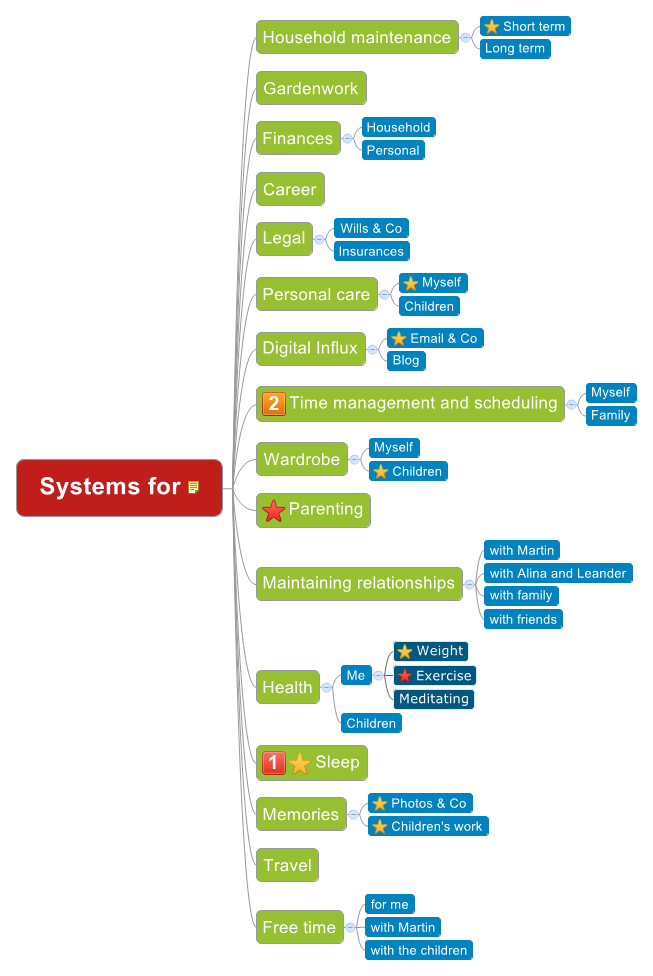
Perhaps it is wise to start with a listing of all those areas, then decide on one or two to tackle. It will be no easy feat to limit myself to two. But if I learned something crossing from my twenties into my thirties: you can’t do everything, and you most definitely can’t do it all at once. Wouldn’t it be awesome if we could tough? Sigh.
After that I’d like to explore what makes a good system, and how to go about designing it. Lucky thing that I do what I do half my days – a system engineer.
 becomingkay